
If electrical power fails when the Yellow system ELEC PUMP is operating, the pump remains off until the switch is cycled off and on after power has been restored.
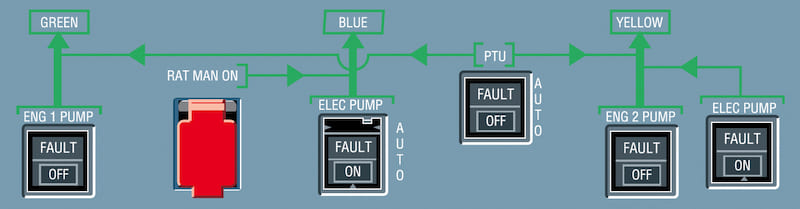
The ENG PUMP FAULT light goes out when the crew selects the pump OFF, except during:
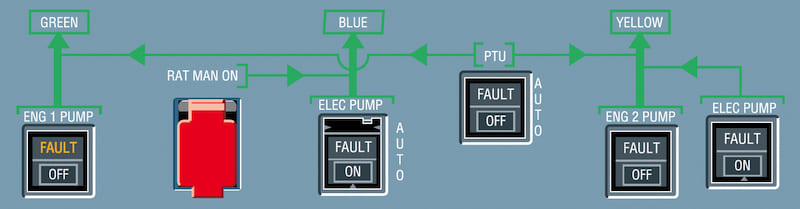
The light will stay on as long as the overheat exists.
In flight, the BLUE hydraulic system is pressurized by:
The PTU is automatically inhibited:
The PTU is automatically inhibited during the first engine start and automatically tested during the second engine start.
The hydraulic fluid can be transferred from one system to another.
In order to pressurize the GREEN hydraulic system when both engines are NOT running.
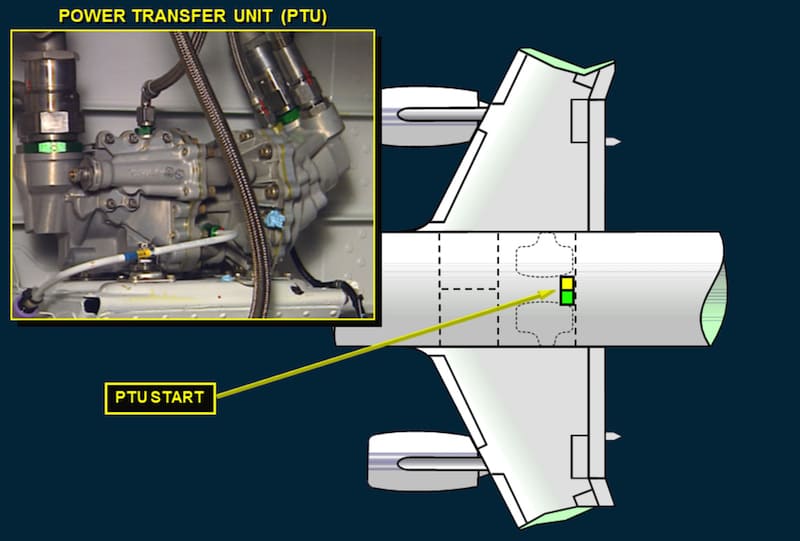
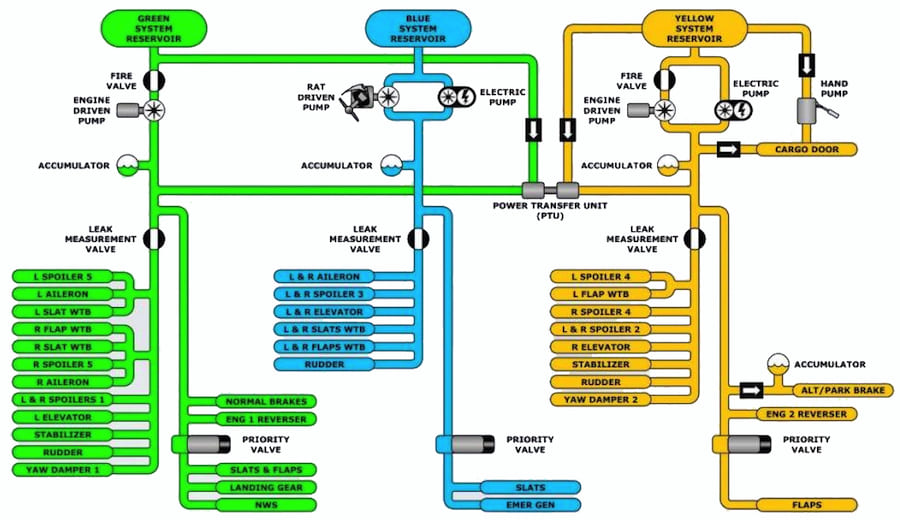
An electric pump can pressurize the YELLOW system, which allows YELLOW hydraulics to be used on the ground when the engines are stooped. The PTU (Power Transfer Unit) comes into action when the differential pressure between the GREEN and the YELLOW systems is greather than 500 psi. The PTU therefore allows the green system to be pressurized on the ground when the engines are stopped.
The YELLOW electric pump pushbutton is set to OFF. If a crewman sets the lever of the cargo door manual selector valve to OPEN or CLOSE position, the PTU and the Flight Controls will be:
It comes on automatically when someone sets the lever of the cargo door manual selector valve to OPEN or CLOSE. This inhibits the operation of other yellow system functions (except alternate braking and engine 2 reverse).
Hydraulic power for the landing gear extension and retraction is provided by the:
An accumulator in each system helps to maintain a constant pressure by covering transient demands during normal operation.
The purpose of the accumulators in each hydraulic system is to:
Advertisement
The RAT is automatically deployed in case of:
The BLUE hydraulic system operates the:
After a HYD G RSVR OVHT ECAM caution, is it possible to recover the GREEN hydraulic system?
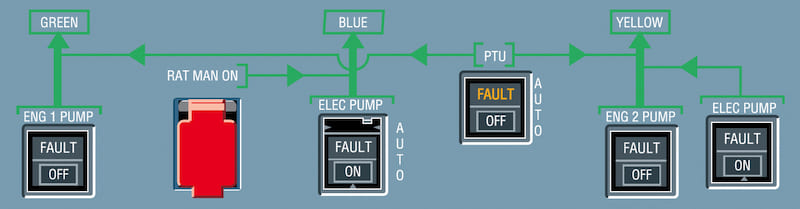
The PTU FAULT light goes out when the crew selects the PTU OFF, except during an overheat (the light stays on as long as the overheat lasts).
During normal operations, hydraulic power is provided by:
The GREEN and YELLOW hydraulic systems have a fire shutoff valve in their line, upstream of the engine-driven pump. The flight crew can close these fire shutoff valves by:
The PTU (Power Transfer Unit) comes into action automatically when the differential pressure between the GREEN and the YELLOW systems is greater than:
The PTU FAULT light comes ON and a caution appears on the ECAM if:
The YELLOW electric pump comes ON automatically when:
Priority valves cut off hydraulic power to heavy load users if hydraulic pressure in a system gets low.
Advertisement
In case of a BLUE hydraulic reservoir overheat, the FAULT light on the overhead panel stays ON:
The RAT (Ram Air Turbine) pressurizes the BLUE hydraulic system to approximately:
Normal system pressure is 3000 psi (2500 psi when powered by the RAT).
In case of a hydraulic malfunction, the RAT will deploy:
Normally, all three hydraulic reservoirs are automatically pressurized by:
During flight, if the BLUE electric pump fails, the BLUE hydraulic system:
An electric pump pressurizes the blue system. A pump driven by a ram air turbine (RAT) pressurizes this system in an emergency.
The YELLOW hydraulic system operates the:
When the guarded pushbutton "RAT MAN ON" is pressed:
The PTU FAULT light comes ON and a caution appears on the ECAM if:
The PTU is automatically tested:
The YELLOW hydraulic system comprises:
A pump driven by engine 2 pressurizes the yellow system. An electric pump can also pressurize the yellow system, which allows yellow hydraulics to be used on the ground when the engines are stopped. Crew members can also use a hand pump to pressurize the yellow system in order to operate the cargo doors when no electrical power is available.
Advertisement
A hand pump pressurizes the YELLOW hydraulic system in order to operate the _____ when no electrical power is available.
Each of the ____ and ____ hydraulic systems has a fire shutoff valve in its line upstream of its pump.
On the ECAM HYD page, the "LO AIR PRESS" appears in amber along with a caution message if:
The ENG 1 PUMP FAULT light is inhibited on the ground when the engine is stopped, if it is triggered due to low pump pressure.
Is it possible to check RAT's position and status?
In case of HYD G (Y) (B) RSVR LO AIR PR, the affected hydraulic system:
Each of the green and yellow systems has a fire shutoff valve in its line upstream of its engine-driven pump. The flight crew can close it by pushing the ENG 1(2) FIRE pushbutton.
The YELLOW hydraulic system has _____ pumps to provide pressure (not counting the PTU - Power Transfer Unit)
A pump driven by engine 2 pressurizes the YELLOW system. An electric pump ca also pressurize the YELLOW system, which allows YELLOW hydraulics to be used on the ground when the engines are stopped. Flight crew can also use a hand pump to pressurizethe YELLOW system in order to operate the cargo doors when no electrical power is available.
On the ECAM HYD page, the hydraulic quantity indicator becomes amber when:
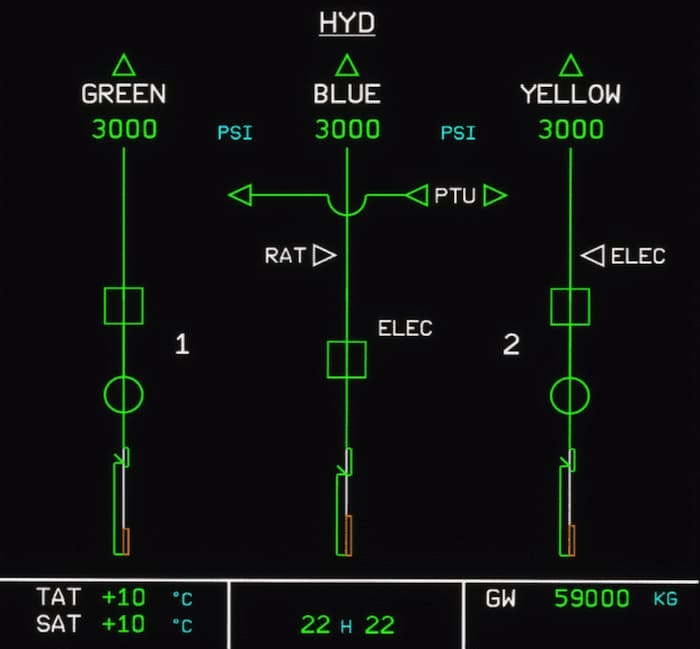
All three hydraulic systems maintain a high pressure at their reservoirs in order to prevent their pumps from cavitation.
Advertisement
After being extended, the RAT can be stowed:
The PTU (Power Transfer Unit) is a bidirectional unit that enables the yellow system to pressurize the green system and vice versa.
The BLUE hydraulic system operates the:
The RAT can be extended:
When the YELLOW electric pump is automatically activated, it inhibits the operation of the other YELLOW system functions except:
When extended in flight, the RAT is coupled to a hydraulic pump and pressurizes the:
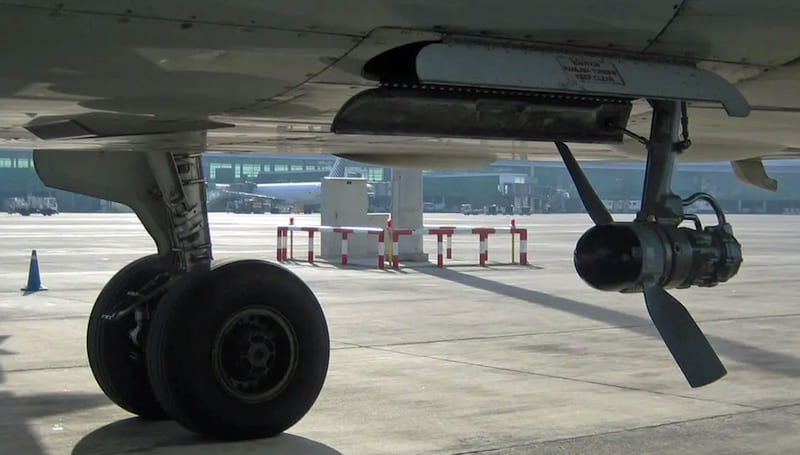
A drop-out RAT coupled to a hydraulic pump allows the blue system to function if electrical power is lost or both engines fail.
Normally, HP bleed air from engine 1 pressurizes the hydraulic reservoirs automatically. If the bleed air pressure is too low or too high, the system takes bleed air pressure from the crossbleed duct.
Only when the bleed air pressure is too low, the system takes bleed air pressure from the crossbleed duct. The systems maintain a high enough pressure to prevent their pumps from cavitating.